Tuileries Gardens
Little WomenTuileries Gardens is a public garden in Paris that Amy Curtis March visits during her European tour. Her brief account places it within a chain of urban sights, museums, monuments, and fashionable promenades, making the garden less a site of dramatic action than a setting through which travel, memory, taste, and self-education become visible.
Setting and Description
Tuileries Gardens belongs to the Parisian landscape Amy Curtis March explores with the Vaughns. She writes that the travelers often walk there because the gardens are lovely, while adding that she prefers the Luxembourg Gardens. This comparison gives the place a distinct role in her account: it is admired and repeatedly visited, but Amy's judgment remains active rather than merely reverential. She does not treat every famous site as equally compelling; she ranks places according to her developing personal taste.
The garden appears alongside the Louvre, the Palais Royale, the Bois, the Champs Elysees, and Père Lachaise. Together, these locations create a map of Paris assembled through movement and selective attention. The Tuileries Gardens represent cultivated public beauty, whereas Père Lachaise draws Amy toward tombs and visible memorial practices, and the Louvre draws her toward painting. The garden therefore participates in a wider contrast between open urban space, artistic institutions, and places where history is preserved through objects or the dead.
Amy's European Experience
Amy's visit to Tuileries Gardens forms part of an energetic itinerary of sightseeing, lunches in cafes, and unexpected adventures. Rainy days are spent in the Louvre, while walks occupy other portions of the tour. The garden is thus encountered through the rhythm of travel rather than isolated contemplation: it is one stop in a life shaped by constant looking, comparing, and recording.
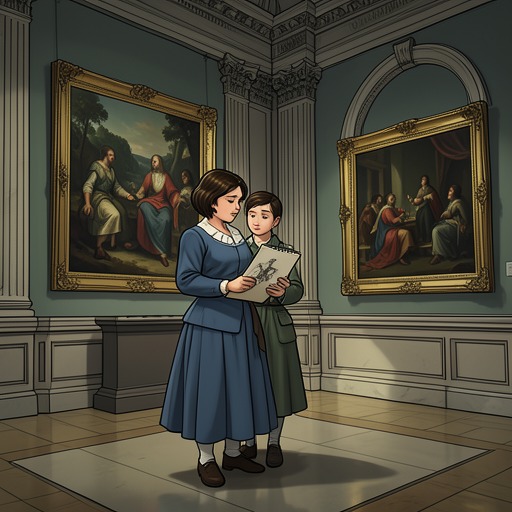
Her observations also show that Amy is consciously turning travel into education. She keeps a diary and tries to remember accurately and describe clearly what she sees, following advice from her father. Her sketchbook supplements the letters, allowing her to preserve impressions in more than one form. Tuileries Gardens consequently matters not only as a beautiful location but also as material for Amy's formation as an observer and writer.
Spatial and Social Significance
The garden's public character contrasts with the enclosed domestic spaces that organize the March family's earlier life. At the March family home, the garden is divided from the Laurence mansion by a low hedge, a modest boundary that separates a comparatively bare and shabby house from a stately stone mansion marked by comfort and luxury. Jo's imagination turns the Laurence mansion into an enchanted palace, and the hedge becomes the edge across which curiosity, friendship, and social difference are negotiated.
Against that local topology, Tuileries Gardens offers a different kind of access. Amy enters a celebrated public landscape as part of an international journey, moving through the city with companions and interpreting what she encounters. The garden is not presented as private property or as a forbidden threshold. Its importance lies in the way a shared civic space becomes a stage for cultural distinction: Amy visits, compares, judges, and converts the experience into a written record.
Narrative Function
Tuileries Gardens helps broaden the novel's world beyond the March neighborhood without displacing its interest in character. Amy's report does not simply catalogue Parisian attractions. It reveals her ambition to cultivate an eye and a taste, her pleasure in fashionable and historical surroundings, and her desire to describe the tour for readers at home. Her preference for the Luxembourg Gardens also preserves the individuality of her response within the prestige of the famous site.
The garden therefore embodies a transitional form of knowledge. Amy is still learning how to see, but she is no longer a passive recipient of grand impressions. By placing Tuileries Gardens among museums, avenues, cafes, and cemeteries, the narrative makes travel a practice of selection and interpretation. The location contributes to Amy's larger movement from sheltered family life toward an increasingly self-conscious understanding of art, society, and the world beyond the March family home.